






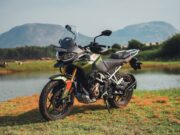










India Kawasaki Motors (IKM) has officially rolled out the MY27 Kawasaki Versys 1100, bringing its flagship adventure-tourer to Indian shores with an ex-showroom starting price of INR 13,89,000. Embracing the rallying cry “Destination: Everywhere”, the updated big-bore tourer lands with a displacement bump, taller gearing for long-distance highway comfort, beefier braking hardware, and upgraded onboard tech.
Deliveries for the MY27 model across India are set to begin from mid-September 2026.
Colours, Pricing, and Official Accessories
Highlighting the launch, Yutaka Yamashita, Managing Director of India Kawasaki Motors, noted that the Versys 1100 combines signature Kawasaki performance, refined long-distance comfort, and practical technology for everything from daily commutes to cross-country road trips. He added that the bike’s true depth shines through the more miles a rider racks up. Kawasaki also reiterated its endurance pedigree through its ongoing partnership as an Official Partner of the Tour de France, providing logistical and safety motorcycle support along the race route.
The MY27 Kawasaki Versys 1100 arrives in a dual-tone Metallic Matte Graphene Steel Gray / Metallic Diablo Black livery, with prices starting at INR 13,89,000 (ex-showroom).
IKM has also made a full suite of factory accessories available, including:
- Bi-Directional Quick Shifter (KQS)
- LED fog lamps
- Large touring windscreen
- Hand covers (knuckle guards)
- Radiator screen
- Resin frame sliders & front axle sliders
- Tank pad & knee pads
Upgraded 1,099cc In-Line Four Engine and Performance
At the core of the MY27 update is an enlarged 1,099cc liquid-cooled, 4-stroke, DOHC in-line four-cylinder engine. Kawasaki engineers have tuned the unit to deliver linear, flexible power across the rev range, focusing heavily on stout low-to-mid-range punch for effortless overtaking and touring.
Crucially, the bike manages to deliver higher performance whilst improving fuel economy simultaneously. This balance has been achieved through revised internal engine components, a lowered rev ceiling, and taller ratios for both 5th and 6th gears to keep highway cruising smooth and frugal. The powerplant is mated to a 6-speed return transmission.
- Engine Capacity: 1,099cc (1,099 cm3)
- Maximum Power: 135 PS @ 9,000 rpm
- Maximum Torque: 112 Nm @ 7,600 rpm
Chassis, Suspension, and Upgraded Brakes
The Versys 1100 is built around a lightweight, high-rigidity aluminium twin-tube frame that uses the engine as a stressed member. Kawasaki has routed the beams directly above the cylinder head, creating a slim midsection that gives riders an easy, natural knee grip and a planted yet agile front-end feel.
To soak up real-world tarmac imperfections like potholes, ruts, and cobblestones, the machine runs dedicated long-travel road suspension:
- Front Suspension: 43 mm inverted telescopic fork offering 150 mm of wheel travel, equipped with rebound damping adjustment (right fork leg) and spring preload adjustability.
- Rear Suspension: Horizontal Backlink, gas-charged rear monoshock delivering 152 mm of wheel travel, featuring adjustable rebound damping and a remote spring preload adjuster knob.
Braking gets a direct upgrade to match the bigger engine. Up front, twin 310 mm discs are clamped by radial-mount opposed 4-piston monobloc callipers using differentiated piston diameters (32 mm upper and 30 mm lower). At the rear, the disc diameter grows from 250 mm to 260 mm, gripped by a single-piston calliper for increased stopping authority.
Advanced Electronics and Comprehensive Rider Aids
The MY27 Versys 1100 carries an extensive electronic rider aid package driven by a compact Inertial Measurement Unit (IMU):
- KCMF (Kawasaki Cornering Management Function): Kawasaki’s total engine and chassis management system monitors feedback across chassis pitch, roll, and yaw from corner entry right through apex to exit, modulating engine power and braking to help riders track their intended line. Depending on the model spec, KCMF oversees traction, wheel lift, launch control (KLCM), pitching, and engine braking.
- KIBS (Kawasaki Intelligent Anti-lock Brake System): A supersport-derived system that bridges the ABS ECU directly with the engine ECU, reading wheel speed, calliper hydraulic pressure, throttle opening, gear position, and clutch actuation. It modulates pressure in tiny increments, reduces front-lever kickback, accounts for back-torque, and curbs rear-wheel lift under heavy braking.
- KTRC (Kawasaki Traction Control): Offers three selectable intervention modes plus an ‘Off’ setting. Mode 1 prioritises maximum forward acceleration, Mode 2 balances acceleration with stability, and Mode 3 ensures maximum reassurance on low-grip or slick surfaces.
- Power Modes: Riders can toggle between Full Power and Low Power (which dials back output to roughly 75% of peak with gentler throttle mapping).
- Cruise Control: Electronic Cruise Control comes standard for relaxed motorway mile-munching.
- Updated Quick Shifter (KQS): Available as an optional accessory, the contactless bi-directional quickshifter allows clutchless upshifts and downshifts, now engaging from a lower threshold of 1,500 rpm (down from 2,500 rpm).
Cockpit, Comfort, and Touring Amenities
Rider data is presented on a high-contrast negative LCD instrument cluster (crisp white typography on a black background). The console includes a digital speedometer, gear indicator, fuel gauge, twin trip meters, clock, odometer, real-time and average fuel economy figures, range readout, intake air and coolant temperatures, bank angle display with max bank angle memory, Economical Riding Indicator, and IMU status.
For long-haul touring comfort, the Versys 1100 provides an upright, relaxed riding triangle that accommodates diverse riding postures (lean-in, lean-with, or lean-out). Up front, an aerodynamically designed upper cowl and wide fairings channel air around the rider, paired with an adjustable windscreen that offers approximately 65 mm of stepless adjustment without tools using two internal knobs.
Practical charging needs are sorted via a new handlebar-mounted USB Type-C port fitted as standard equipment, accompanied by a 12V DC socket integrated into the cockpit powered by a high-output generator.