















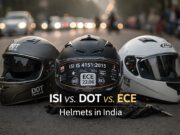

In the vast and often confusing world of motorcycle helmets, a critical aspect that frequently stumps Indian riders is the array of safety certifications stamped on these life-saving pieces of gear. You’ve likely seen them: ISI, DOT, ECE. But what do these acronyms really mean? Are some better than others? And, perhaps most importantly, which one genuinely matters for you, the rider, on Indian roads?
This comprehensive guide will demystify these certifications, delve into their origins, testing methodologies, and legal implications in India. By the end, you’ll be equipped to make an informed decision that prioritizes your safety without falling prey to marketing jargon or misinformation.
The Genesis of Safety Standards: Why Certifications Exist
Before we dive into the specifics of each standard, it’s crucial to understand why these certifications came into being. Helmets are designed to protect the most vital and fragile part of your body: your brain. Without robust and standardized testing, manufacturers could produce helmets that look safe but offer little to no real protection in a crash.
Safety certifications ensure that a helmet has undergone a series of rigorous tests to prove its ability to withstand impacts, punctures, and strap failures. They provide a baseline guarantee of protection, giving riders peace of mind that their helmet isn’t just a stylish accessory, but a genuinely protective device.
1. ISI: The Indian Standard (IS 4151)
What is ISI? ISI stands for Indian Standards Institution, now known as the Bureau of Indian Standards (BIS). The IS 4151 standard is the mandatory certification for all two-wheeler helmets sold and used in India. It was established to ensure that helmets manufactured or imported into the country meet a minimum level of safety specific to Indian road conditions and climate.
History and Evolution
The ISI mark has been a long-standing symbol of quality in India across various products. For helmets, the IS 4151 standard has seen several revisions. The most recent mandatory revision, IS 4151:2015, brought significant changes to align Indian standards closer to global benchmarks.
Key Aspects of ISI Testing (IS 4151:2015)
The ISI standard focuses on several critical areas of helmet performance:
- Impact Absorption: This is the most crucial test. Helmets are dropped onto various anvil shapes (flat, kerb) from specified heights to measure the force transmitted to a dummy head inside. The permissible head acceleration limit is 250g (g-force).
- Penetration Resistance: A pointed striker is dropped onto the helmet shell to test its resistance to sharp object penetration. This prevents foreign objects from piercing the skull.
- Retention System (Chin Strap) Strength: The chin strap is tested for its ability to withstand a specific load without stretching excessively or failing. This ensures the helmet stays on during an impact.
- Peripheral Vision: The helmet must allow a minimum field of vision (105 degrees to each side) to ensure the rider has adequate peripheral awareness.
- Rigidity and Stability: The shell’s structural integrity and how stable it remains on the head are also assessed.
- Weight Limit: ISI helmets have a maximum permissible weight of 1.2 kg (1200 grams) for full-face helmets. This is a contentious point, as some advanced materials used in international helmets can exceed this limit while offering superior protection.
- Shell Coverage: The standard mandates a certain area of head coverage, which was tightened in the 2015 revision.
Legal Mandate in India
As of January 2019, the Ministry of Road Transport and Highways (MoRTH) made it mandatory for all two-wheeler helmets to be ISI certified. This means selling or using a non-ISI helmet (even if it has DOT or ECE) can result in fines under the Motor Vehicles Act, 1988.
Pros of ISI Certification:
- Legally Compliant: The only legally recognized standard for helmets in India.
- Affordable Options: Promotes the availability of budget-friendly, yet certified, helmets for the masses.
- Local Suitability: Standards are designed with Indian road conditions, traffic density, and climate in mind (e.g., maximum weight to reduce neck strain in heavy traffic).
Cons of ISI Certification:
- Lower Benchmark (Historically): Older versions of ISI (pre-2015) were considered less stringent than international standards. The 2015 revision improved this significantly.
- Weight Limit Restriction: The 1.2 kg weight limit can exclude some highly protective, advanced material helmets (like those made of carbon fiber) that might exceed this weight.
- Perception: Historically, there’s been a perception that ISI is inferior to international standards, though the gap is narrowing.
2. DOT: The American Standard (FMVSS 218)
What is DOT? DOT stands for the Department of Transportation, a federal agency in the United States. The FMVSS 218 (Federal Motor Vehicle Safety Standard No. 218) is the mandatory standard for all motorcycle helmets sold in the U.S.
Key Aspects of DOT Testing (FMVSS 218)
DOT certification is a self-certification process. This means manufacturers themselves certify that their helmets meet the standard. The DOT then conducts random spot checks and pulls helmets from retail shelves for independent testing.
- Impact Absorption: Helmets are dropped onto a spherical and a flat anvil from various heights. The allowed G-force transmission is 400g.
- Penetration Resistance: A pointed striker is dropped from a specified height.
- Retention System (Chin Strap) Strength: The strap is tested for its ability to hold the helmet securely under load.
- Peripheral Vision: Similar to ISI, a minimum field of vision is required.
- Location Specificity: Impact and penetration tests are conducted on any point above a specific test line, not just predefined points. This forces manufacturers to ensure uniform protection.
Pros of DOT Certification:
- High Impact Standard: The 400g limit might seem higher than ECE’s 275g (or ISI’s 250g), but DOT allows for two impacts on the same spot, meaning the helmet must be designed for continued protection after an initial hit.
- Uniform Protection: The “anywhere above the test line” testing encourages consistent shell strength.
- Good Baseline: Provides a solid, widely recognized safety standard.
Cons of DOT Certification:
- Self-Certification: The fact that manufacturers self-certify can sometimes lead to lower accountability compared to independent third-party testing.
- No Batch Testing: DOT does not require batch testing, so variability between production runs is possible.
- Not Legally Recognized in India: Despite its robust nature, a DOT-only helmet is not legal for use on Indian roads.
3. ECE: The European Standard (ECE Regulation 22.06)
What is ECE? ECE stands for Economic Commission for Europe. ECE Regulation 22 is a globally recognized and highly respected standard for motorcycle helmets. It is mandatory in over 50 countries, primarily in Europe, but also adopted by many non-European countries. The latest iteration, ECE 22.06, significantly raises the bar for helmet safety.
History and Evolution
The ECE 22 standard has been around for decades, with successive revisions adding more stringent tests. ECE 22.05 was the long-standing benchmark, but ECE 22.06 was introduced in 2020 and became mandatory in 2023, marking a monumental leap in helmet safety testing.
Key Aspects of ECE Testing (ECE 22.06)
ECE 22.06 is arguably the most comprehensive helmet standard globally, known for its rigorous independent, third-party testing.
- Impact Absorption (Linear): Helmets are subjected to linear impacts onto various anvils (flat, kerb, edge) from different heights. The G-force limit is 275g.
- Impact Absorption (Rotational): This is a major addition in 22.06. Helmets are tested for their ability to mitigate rotational forces on the brain, which are a primary cause of severe brain injuries like concussions and diffuse axonal injury. This involves oblique impacts on abrasive surfaces.
- Penetration Resistance: Similar to other standards, but often with more varied test points.
- Retention System (Chin Strap) Strength: Tested for dynamic and static strength, ensuring the strap holds in an accident.
- Quick Release Mechanism: Testing ensures quick-release buckles (if present) function correctly.
- Visor Testing: Visors are tested for clarity, distortion, scratch resistance, and optical qualities.
- Accessory Testing: Accessories like integrated sun visors, communication systems, and action camera mounts are now tested with the helmet to ensure they do not compromise safety.
- Varying Impact Speeds: Unlike previous standards, 22.06 includes low-speed, medium-speed, and high-speed impacts to cover a wider range of accident scenarios.
- Random Impact Points: Similar to DOT, impact points are not fixed, forcing uniform shell strength.
Pros of ECE Certification (especially 22.06):
- Most Comprehensive: ECE 22.06 is the current gold standard, with advanced tests for rotational forces, accessory integration, and varied impact speeds.
- Third-Party Testing: Independent labs conduct the testing, ensuring higher accountability.
- Batch Testing: Manufacturers must submit helmets from each production batch for testing, reducing variability.
- Global Recognition: Widely accepted as a benchmark for safety.
Cons of ECE Certification:
- Higher Cost: Due to the extensive testing and higher material requirements, ECE-certified helmets tend to be more expensive.
- Not Legally Recognized in India (on its own): A helmet with only ECE certification is not legal for use on Indian roads.
Read also: Helmet Size Chart India – How to Choose the Right Helmet Size (With Examples)
What Actually Matters for Indian Riders?
Now that we’ve dissected each standard, let’s bring it back to the core question: What actually matters for you, the Indian rider?
The Legal Imperative: ISI is Non-Negotiable
First and foremost, ISI certification is mandatory and non-negotiable for legal riding in India. If your helmet does not bear the ISI mark (specifically IS 4151:2015), you are liable for a fine. This applies even if your helmet is a premium international brand with DOT or ECE certification. Traffic police will primarily check for the ISI mark.
The Safety Imperative: Don’t Compromise
While ISI is a legal requirement, it doesn’t mean you should settle for the bare minimum. Many premium international brands (like MT, LS2, HJC, etc.) that are now officially available in India offer helmets that are dual-certified – meaning they have both ISI and ECE (or sometimes ISI + ECE + DOT) marks.
This is the sweet spot for safety and legality. These helmets meet the stringent international standards while also complying with Indian law.
Understanding the Hierarchy of Protection (Generally)
While it’s not a direct comparison, and each standard has its unique strengths, a general hierarchy of increasing stringency (especially with rotational impact focus) would be:
Older ISI (pre-2015) < DOT < ECE 22.05 < ISI (2015) ≈ ECE 22.05 < ECE 22.06
- ISI 2015 significantly improved Indian standards, making it comparable to basic ECE 22.05.
- ECE 22.06 is currently the gold standard due to its comprehensive rotational impact testing and accessory integration.
The Myth of “Higher G-Force Limit = Less Safe”
Many people mistakenly believe that DOT’s 400g limit means it’s less safe than ECE’s 275g. This is an oversimplification.
- ECE 22.05/06 measures single impacts at various points.
- DOT measures two impacts on the same spot, requiring the helmet to maintain structural integrity and energy absorption capability after an initial hit.
Both are robust standards; they just approach the problem slightly differently. However, ECE 22.06’s inclusion of rotational impact testing gives it an edge in preventing certain types of brain injury.
What About Weight?
The ISI’s 1.2 kg weight limit is often criticized. While lighter helmets can reduce neck strain, extremely lightweight carbon fiber helmets (often ECE certified) can exceed this limit while offering superior impact absorption. If a helmet is ISI certified, it means it meets the weight limit, but don’t automatically assume a slightly heavier ECE-only helmet is less safe; it might just be built with different materials.
Practical Advice for Helmet Buyers in India
- Always Look for the ISI Mark First: This is your primary legal requirement. Ensure it’s the IS 4151:2015 standard.
- Prioritize Dual Certification: If your budget allows, aim for helmets that are ISI + ECE 22.06 certified. This offers the best blend of legality and advanced protection. Many brands like MT, LS2, SMK, and Royal Enfield now offer such options in India.
- Don’t Fall for “DOT-Only” Imports: An expensive helmet imported from the US with only a DOT sticker is not legal in India. You risk a fine.
- Beware of Fake ISI Marks: Buy from authorized dealers and reputable online stores. There are counterfeit helmets with fake ISI stickers. The genuine ISI mark will have a CM/L number (a unique license number) printed on it, which you can verify on the BIS website.
- Fit is Paramount: Remember from our previous blog, even the safest certified helmet is useless if it doesn’t fit correctly. A properly fitting ISI-certified helmet is infinitely safer than a loose, high-end ECE 22.06 helmet.
- Consider Your Riding:
- Daily Commute/City Riding: A well-fitting, good quality ISI helmet might suffice.
- Highway Touring/Spirited Riding: Investing in an ISI + ECE 22.06 helmet provides superior protection against higher-speed impacts and rotational forces.
The Future of Helmet Safety in India
The Indian government’s push for mandatory ISI certification is a positive step towards improving road safety standards for the masses. As global awareness about helmet safety evolves, especially with the advancements seen in ECE 22.06 regarding rotational impact, it’s likely that future revisions of the ISI standard will continue to incorporate these learnings.
The goal is not to shame riders who use ISI-only helmets, but to educate everyone that while ISI is the baseline, pursuing dual-certified helmets offers an enhanced layer of protection. As the market for premium helmets grows in India, manufacturers are responding by offering more models that meet both local legal requirements and international safety benchmarks.
Conclusion
The debate between ISI, DOT, and ECE isn’t about one being inherently “bad” and another “good.” Each serves a purpose within its regulatory framework. For an Indian rider, the most crucial takeaway is this: An ISI certification is a legal necessity. Beyond that, your safety depends on a combination of factors:
- The Right Fit: Always the most critical element.
- The Right Certification: ISI is mandatory; ISI + ECE 22.06 is optimal for advanced protection.
- The Right Type of Helmet: Full-face for maximum protection.
- Regular Replacement: Helmets have a lifespan, even without crashes.
Don’t let the alphabet soup of certifications confuse you. Arm yourself with knowledge, understand the legal landscape, and choose a helmet that will genuinely protect your most valuable asset. Ride safe, ride smart, and ride certified.
Read also: How Often Should You Replace a Motorcycle Helmet? (Indian Conditions)
Frequently Asked Questions (FAQs)
Q1: Is a DOT or ECE-certified helmet legal to wear in India in 2026? A: Legally, no, not on its own. According to the Ministry of Road Transport and Highways (MoRTH), only helmets bearing the ISI (IS 4151:2015) mark are recognized as legal protective headgear. If your helmet has only DOT or ECE stickers, a traffic cop can technically issue a challan. To stay safe and legal, look for dual-certified helmets that carry both the ISI mark and international certifications.
Q2: What is the fine for wearing a non-ISI helmet in India? A: As of 2026, the standard fine for wearing a non-ISI certified helmet (or riding without one) is ₹1,000. In some states, this violation can also lead to the disqualification or suspension of your driving license for up to three months. Additionally, if you are caught with the helmet strap unfastened, you can face an additional fine of ₹1,000.
Q3: Does ECE 22.06 provide better protection than ISI? A: Generally, yes. While the ISI (2015) standard is robust and comparable to the older ECE 22.05, the ECE 22.06 is the most advanced standard today. Its biggest advantage is rotational impact testing, which measures how well a helmet protects your brain from “twisting” forces during a slide—a major cause of concussions that standard linear impact tests (like ISI or DOT) don’t fully address.
Q4: Can I just stick an ISI sticker on my imported DOT/ECE helmet? A: Absolutely not. Applying a fake ISI sticker to a non-certified product is a serious offense under the BIS Act. If caught, the penalties for using a counterfeit mark can reach up to ₹5 lakh or even imprisonment. Genuine ISI marks are embossed or printed permanently by the manufacturer and include a unique CM/L license number that can be verified on the BIS website.
Q5: Why do some international premium brands not have the ISI mark? A: For a helmet to get the ISI mark, the manufacturer must set up a testing process that complies with Indian Bureau of Standards (BIS) regulations, which often involves factory inspections in the country of origin. Some low-volume, high-end brands find this process too expensive or logistically difficult, so they only certify for global markets (DOT/ECE). However, many top brands like MT, LS2, and AGV are now officially certifying their Indian stock with ISI marks.
Q6: Will my insurance claim be rejected if I’m wearing a DOT/ECE-only helmet during a crash? A: There is a high risk. Most Indian insurance policies have a clause stating that the rider must follow all traffic laws. Since wearing a non-ISI helmet is a violation of the Motor Vehicles Act, an insurance company could potentially use this as a ground to reject your personal accident claim. Using an ISI-certified helmet protects both your head and your financial safety.
Q7: I heard that from 2026, new bikes must come with two helmets. Is that true? A: Yes! Starting January 1, 2026, the Indian government has mandated that all new two-wheelers sold must include two BIS-certified (ISI) helmets—one for the rider and one for the pillion. This is part of a larger safety push that also makes ABS (Anti-lock Braking System) mandatory for all engine capacities.
















This was a really helpful read. I think a lot of riders tend to focus only on the certification mark and forget that the right fit and proper fastening are just as important. The explanation of ECE 22.06 was also interesting, especially the part about rotational impact protection. Good to see the differences explained in a way that’s easy to understand.
Hi Aditya, thank you! Ride safe!