




















In India, a helmet is often viewed as a legal necessity to avoid a fine. However, in reality, it is the most critical piece of safety gear you will ever own. But here is the catch: a helmet that doesn’t fit correctly is almost as dangerous as not wearing one at all.
If your helmet is too loose, it can rotate or fly off during an impact. If it’s too tight, it will give you a headache within ten minutes, leading to a lack of concentration on the road. This comprehensive guide will walk you through the nuances of the Helmet Size Chart in India, how to measure your head, and how to choose the right lid for your daily commute or weekend tours.
Why Helmet Size Matters More Than You Think
When you involve yourself in a crash, a helmet has two jobs:
- To prevent skull penetration.
- To absorb the kinetic energy that would otherwise rattle your brain.
If there is a gap between your head and the internal EPS (Expanded Polystyrene) liner because the helmet is too big, your head will accelerate into the liner during a crash. This “secondary impact” inside the helmet can cause severe internal injuries. Conversely, a helmet that is too small won’t sit low enough on your forehead, leaving your base of the skull or brow exposed.
Step 1: How to Measure Your Head for a Helmet
Before looking at any size chart, you need an accurate measurement of your head. Indian head shapes often lean towards “Intermediate Oval” or “Long Oval,” which can affect how certain international brands fit compared to homegrown brands like Steelbird, Vega, or Studds.
Tools You Need:
- A flexible cloth measuring tape (tailor’s tape).
- If you don’t have one, use a piece of string and a ruler.
- A mirror or a friend to help.
The Measurement Process:
- Placement: Wrap the tape around the widest part of your head. This is usually about one inch (2.5 cm) above your eyebrows, just above your ears, and around the bump at the back of your head (the occipital protuberance).
- Level Check: Ensure the tape is level all the way around. It shouldn’t be sagging at the back or tilted too high on the forehead.
- The Reading: Pull the tape snug, but not tight. Note the measurement in centimeters (cm). In India, most manufacturers use centimeters as the primary unit of measurement.

Step 2: The Standard Indian Helmet Size Chart
While every brand has slight variations, most Indian and international brands follow a standard sizing convention.
General Helmet Size Reference Table
| Size | Head Circumference (cm) | Head Circumference (Inches) |
| Extra Small (XS) | 53 – 54 cm | 20.8″ – 21.2″ |
| Small (S) | 55 – 56 cm | 21.6″ – 22.0″ |
| Medium (M) | 57 – 58 cm | 22.4″ – 22.8″ |
| Large (L) | 59 – 60 cm | 23.2″ – 23.6″ |
| Extra Large (XL) | 61 – 62 cm | 24.0″ – 24.4″ |
| Double XL (XXL) | 63 – 64 cm | 24.8″ – 25.2″ |
Pro Tip: If your measurement falls exactly between two sizes (e.g., 58.5 cm), it is generally safer to size down. A helmet will “break in” as the cheek pads compress, but it will never get smaller.
Note that while the measurements in centimeters are the most accurate way to compare, the internal head shape (Oval vs. Round) varies by brand. For example, an “M” in Studds might feel different from an “M” in MT due to the density of the padding and the shell shape.
Helmet Size Comparison Table: India’s Top Brands
Size Head (cm) Studds Vega MT Helmets LS2 XS 53 – 54 54 cm 54 cm 53-54 cm 53-54 cm S 55 – 56 56 cm 56 cm 55-56 cm 55-56 cm M 57 – 58 57-58 cm 58 cm 57-58 cm 57-58 cm L 59 – 60 58-60 cm 60 cm 59-60 cm 59-60 cm XL 61 – 62 60-62 cm 62 cm 61-62 cm 61-62 cm XXL 63 – 64 62-64 cm – 63-64 cm 63-64 cm
Step 3: Understanding Head Shapes
Size is only half the battle. The shape of your head is equally important. In the world of helmets, there are three primary shapes:
- Long Oval: For heads that are significantly longer from front-to-back than side-to-side.
- Intermediate Oval: The most common shape in the Indian market. It is slightly longer front-to-back than side-to-side.
- Round Oval: For heads that are almost equal in both dimensions.
If you have a “Long Oval” head but buy a “Round Oval” helmet, you will feel painful pressure on your forehead (often called “Hot Spots”) while having huge gaps at the temples.
Step 4: The “Fit Test” – How to Know It’s Right
Once you have the helmet on, don’t just take it off immediately. Perform these four tests:
1. The Eye-Port Check
The top of the helmet’s eye port should sit about one finger-width above your eyebrows. If it’s higher, your forehead is unprotected. If it’s lower, your vision is obstructed.
2. The “Chipmunk Cheek” Test
A well-fitting full-face helmet should press against your cheeks, pushing them up slightly. If you open your mouth and don’t slightly bite your cheeks, the helmet is likely too loose.
3. The Roll-Off Test
Fasten the chin strap securely. Grab the back of the helmet and try to pull it forward over your head. Then, grab the front and try to pull it backward. If the helmet moves significantly or starts to come off, it is the wrong size or shape.
4. The 10-Minute Trial
Wear the helmet around the shop for at least 10 to 15 minutes. Pressure points (hot spots) often take time to manifest. If you feel a dull ache in your forehead or temples after 10 minutes, put it back and try a different shape.
Read also: Helmet Size Chart India – How to Choose the Right Helmet Size (With Examples)
Step 5: Brand-Specific Examples in India
To make this easier, let’s look at how the top Indian brands categorize their sizes.
1. Vega Helmet Size Chart
Vega is one of India’s most popular brands. Their sizing tends to be very consistent.
- M: 580mm (58cm)
- L: 600mm (60cm)
- XL: 620mm (62cm)

2. Steelbird Helmet Size Chart
Steelbird often caters to a younger demographic with aggressive styling. Their “Ignite” series might feel snugger than their “Air” series due to thicker padding.
- S: 560mm
- M: 580mm
- L: 600mm

3. Royal Enfield Helmets
Since many RE riders go for the “Open Face” or “Urban” look, sizing feels different. Without a chin bar, these helmets can feel looser. Always ensure the “side-to-side” fit is snug to prevent the helmet from lifting at high speeds.

Step 6: Different Helmet Types and Sizing Nuances
In India, we use various types of helmets depending on the bike and the weather. Each has its own fit considerations.
Full-Face Helmets
These offer the most protection. Because they wrap around the jaw, they feel the tightest. Do not be alarmed by the tightness around the neck; focus on the crown of the head.
Modular (Flip-Up) Helmets
Modular helmets have a hinge. Because of this mechanical part, the shell is often slightly larger. Ensure that when the chin bar is locked down, it doesn’t press against your chin. There should be about a thumb’s width of space between your chin and the bar.
Open-Face (Half) Helmets
Commonly used for scooters like the Activa or Jupiter. These are easier to fit but offer zero chin protection. Ensure the straps are high quality, as there is no chin bar to help keep the helmet stable.
[Image showing different types of helmets: Full Face, Modular, and Open Face]
Common Mistakes Indian Buyers Make
1. Buying “Free Size”
There is no such thing as a “one size fits all” brain. Avoid roadside vendors selling “Free Size” helmets. These are usually non-ISI certified and provide a false sense of security.
2. Buying for the “Pillion”
Often, people buy a cheap, oversized helmet for their passenger. Physics doesn’t care who is driving; the passenger’s head needs the same precision fit as the rider’s.
3. Ignoring the ISI Mark
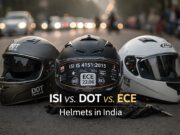
As of recent Indian laws, it is mandatory to wear an ISI (IS 4151:2015) certified helmet. When checking for size, also look for the ISI sticker at the back and the CM/L number. If you can afford it, look for ECE 22.06 or DOT certifications as well, which are international safety standards.
How to Maintain Your Helmet Fit
Over time, the inner liners (cheek pads) will compress. This is called “breaking in.”
- First 500 KM: The helmet will feel 5% to 10% looser than when you bought it.
- Washable Liners: If your helmet starts feeling loose, check if the liners are removable. Sometimes a good wash of the cheek pads can “fluff” the foam back up.
- Replacement: If the helmet moves freely when you shake your head “No,” it’s time to replace the pads or the helmet itself. Generally, a helmet should be replaced every 3–5 years because the EPS liner hardens and loses its ability to absorb shock.
Summary Checklist for Choosing Your Helmet
- Measure: Use a tape to find your circumference in cm.
- Cross-Reference: Match your cm to the brand’s specific size chart.
- Identify Shape: Determine if you are Long, Intermediate, or Round oval.
- The Fit: Ensure it’s “snug” (chipmunk cheeks) but doesn’t cause pain.
- The Strap: Ensure the chin strap can be tightened so only two fingers fit between the strap and your throat.
- Certification: Check for the ISI mark.
Frequently Asked Questions (FAQs)
Q1: My head measurement is 58.5 cm. Should I buy a Medium (58 cm) or a Large (60 cm)? A: In most cases, you should size down to a Medium. Helmets feature a foam liner that “breaks in” and compresses over the first few weeks of use. If you buy the Large, it may feel comfortable now, but it will likely become too loose and wobble at high speeds after a month of riding.
Q2: Is it okay to buy a helmet without an ISI mark if it has DOT or ECE certification? A: For safety, DOT (US) and ECE (Europe) are excellent standards. However, legally in India, your helmet must have the ISI (IS 4151) mark. Indian law requires manufacturers to meet ISI standards for a helmet to be considered legal on public roads. Many premium brands now offer “dual-certified” helmets (e.g., ISI + ECE) which give you the best of both worlds.
Q3: Why does my helmet feel too tight on my cheeks even though the size is correct? A: This is normal! Full-face helmets are designed to grip your jaw to prevent the helmet from rotating during an impact. This is often called the “Chipmunk Cheek” fit. As long as the helmet isn’t causing a sharp pain in your forehead or temples (pressure points), the cheek pads will eventually soften and conform to your face.
Q4: Can I buy a helmet for my child using this same size chart? A: While the measurement technique is the same, it is better to look for Youth-specific helmets. A child’s neck muscles are not as strong as an adult’s. Even if an “XS” adult helmet fits a child’s head circumference, the weight of the adult shell might be too heavy, posing a risk of neck injury during sudden braking or an accident.
Q5: How often should I replace my helmet even if it hasn’t been in an accident? A: Most manufacturers recommend replacing your helmet every 3 to 5 years. The internal EPS (the white shock-absorbing foam) degrades over time due to sweat, hair oils, and temperature changes, becoming brittle and losing its ability to protect your brain.
Q6: I wear spectacles. How should I choose my helmet size? A: Measure your head as usual, but when trying on helmets, look for models labeled “Goggle/Specs Compatible.” These have small grooves in the padding for the arms of your glasses. Put the helmet on first, then slide your glasses through the visor. If the glasses are pressed painfully against your face, you may need a different brand/shape rather than a larger size.
Q7: Will a loose helmet really fail in an accident? A: Yes. If a helmet is loose, it can shift during a crash, potentially leaving your chin or forehead exposed. More importantly, it can cause a “secondary impact”—where your head hits the inside of the helmet after the helmet hits the ground—which significantly increases the risk of a concussion.
Q8: Can I wash the inside of my helmet to keep the fit snug? A: If your helmet has a removable liner, you can hand-wash it with a mild baby shampoo. This removes oils and sweat that cause the foam to compress. While it won’t make a worn-out helmet “new” again, it can help restore some of the original snugness.
Read also: How Often Should You Replace a Motorcycle Helmet? (Indian Conditions)
Conclusion
Choosing the right helmet size in India is a mix of science and feel. While the size chart gives you a starting point, the “10-minute rule” and the “roll-off test” are your best friends in the shop. Remember, a stylish helmet is great, but a well-fitted, ISI-certified helmet is what will actually save your life.
Investing time in measuring your head today could prevent a lifetime of regret tomorrow. Whether you are cruising on a Bullet, zipping through traffic on a Duke, or commuting on an Access, your safety starts with the perfect fit.