




















You’ve seen him on the streets of Mumbai or Delhi—the “Legend.” He’s riding a vintage Bullet, wearing a helmet that looks like it survived the Third Battle of Panipat. It’s faded, the visor is held up by hope and a piece of electrical tape, and the padding is so thin he’s basically wearing a plastic bucket with a chin strap.
We Indians love “mileage”—not just in our fuel tanks, but in our gear. We take pride in making things last. But when it comes to your motorcycle helmet, that “Paisa Vasool” (value for money) mindset can be fatal.
If you’re wondering, “How often should I replace my motorcycle helmet?”, the short answer is every 3 to 5 years. However, in the chaotic, sun-baked, and dust-choked reality of Indian roads, the “real” answer is much more nuanced.
In this comprehensive guide, we’ll dive into the science of helmet degradation, the brutal impact of Indian weather, and the signs that your “trusted lid” has turned into a dangerous liability.
Read also: Helmet Size Chart India – How to Choose the Right Helmet Size (With Examples)
1. The Science of the “Expiry Date”: Why Helmets Don’t Last Forever
A common myth among Indian riders is that if a helmet hasn’t been in an accident, it’s “good as new.” Unfortunately, physics and chemistry disagree. A helmet is a sophisticated piece of safety engineering made of materials that naturally degrade over time.
The EPS Liner: Your Brain’s Only Friend
The most critical part of your helmet isn’t the shiny outer shell; it’s the Expanded Polystyrene (EPS) liner inside. Think of EPS as high-density thermocol. Its sole job is to crush upon impact, absorbing the energy that would otherwise turn your brain into a milkshake.
Over time, the oils from your hair, sweat, and even the ambient moisture in the air cause the EPS to become brittle and lose its “crushability.” An old EPS liner won’t absorb impact; it will simply pass the force directly to your skull.
The Shell Material
Most budget-friendly helmets in India are made of polycarbonate (plastic). While tough, polycarbonate is sensitive to UV rays. After years of sitting in the blistering 45°C Indian summer, the plastic can become “photo-degraded,” making it brittle. High-end helmets use Fiberglass or Carbon Fiber, which last longer but still rely on the same degrading EPS liner.
2. The “India Factor”: Why Our Conditions Are Brash on Gear
Global manufacturers often base their “5-year rule” on European or North American climates. In India, our helmets face a gauntlet of environmental stressors that significantly accelerate the aging process.
The Blistering Heat and UV Exposure
Whether you’re stuck in a Bangalore traffic jam or cruising through the Rajasthan desert, your helmet is a heat magnet. Intense UV exposure breaks down the chemical bonds in the outer shell and the adhesives holding the liners together. If you store your helmet on your bike’s mirror in the sun, you’re effectively “cooking” the safety out of it.
Humidity and the “Monsoon Funk”
In coastal cities like Mumbai, Chennai, or Kolkata, humidity is a silent killer. Moisture gets trapped in the comfort padding, leading to the growth of mold and bacteria. Beyond the “funky smell,” this organic growth can actually speed up the deterioration of the inner foam.
Pollution and Acidic Road Grime
Indian roads are a cocktail of dust, diesel exhaust, and chemical residue. These pollutants can react with the paint and the protective coatings of your helmet. Acidic rain during the monsoon is particularly harsh on the visor and the rubber seals.
3. Top 5 Signs You Need to Replace Your Helmet Right Now
You don’t always need a calendar to tell you it’s time for a change. Your helmet will give you “warning signs.” Ignore them at your own peril.
1. The “Bobblehead” Effect (Loose Fit)
When you first bought your helmet, it was probably snug—maybe even a bit tight. Over time, the comfort padding (the soft foam) compresses. If you can shake your head and the helmet wobbles, or if you can fit more than two fingers between your forehead and the liner, it’s dead. In a crash, a loose helmet will rotate or even fly off your head before it can do its job.
2. The “Snowing” Liner
Have you ever taken your helmet off and found tiny black or white flakes in your hair? That’s not dandruff; that’s your internal liner disintegrating. This is a clear sign that the materials have reached their chemical limit.
3. Cracks in the EPS
If you pull back the comfort liner and see visible cracks or deep indentations in the hard foam (EPS), stop wearing it. These are structural failures.
4. Fraying Straps or Rusty Buckles
The retention system (the strap) is what keeps the helmet on your head. In India, sweat-induced salt buildup can rust metal “D-rings” or micrometric buckles. If the strap is fraying or the buckle doesn’t “click” with authority, your helmet is essentially a very expensive hat.
5. Deep Visor Scratches
If your visor looks like a cat used it as a scratching post, your vision is compromised—especially during night riding when oncoming headlights create a blinding glare. While you can replace visors, if the mounting mechanism itself is loose or cracked, it’s time for a new lid.
4. The “One-Drop” Rule: Fact or Fiction?
This is the most debated topic in Indian biker circles. “I just dropped it from the seat of my Activa; do I really need a new one?”
The Reality:
Helmets are designed to be single-use items. They are sacrificial. The EPS liner is designed to collapse once.
- The “Empty” Drop: If an empty helmet falls from your handlebar or seat (about 3 feet) onto the pavement, the shell is usually tough enough to handle it. However, check for hairline cracks.
- The “Loaded” Drop: If there is anything inside the helmet (like a heavy lock or your head) when it falls, the EPS liner will compress to absorb that weight. Even if the outside looks fine, the “crush zone” is now used up.
Pro-Tip: If you’ve been in a minor “low-side” or even a small tumble where your head hit the ground, the helmet’s life is over. No exceptions.
5. Understanding Helmet Safety Certifications in 2026
When you go to buy your replacement, don’t just look at the graphics. Look at the sticker on the back.
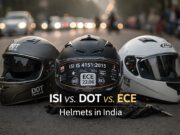
ISI (IS 4151:2015) – The Legal Minimum
In India, it is illegal to sell or wear a non-ISI certified helmet. The Bureau of Indian Standards (BIS) has tightened these rules. As of January 2026, the government has even mandated that two-wheeler dealers provide two ISI-certified helmets with every new vehicle purchase.
ECE 22.06 – The Gold Standard
If you value your life more than the “minimum legal requirement,” look for ECE 22.06 certification. This is the latest European standard and is much more rigorous than the older ECE 22.05 or DOT. It tests for rotational impact (the twisting motion that causes brain shearing) and various speeds of impact.
DOT (FMVSS 218)
The US standard. While better than a “roadside” helmet, DOT is a self-certified standard, meaning manufacturers test their own helmets. In the Indian market, always prioritize ECE or ISI over standalone DOT.
| Standard | Rigor | Best For |
| ISI | Basic / Mandatory | City Commuting (Slow speeds) |
| DOT | Moderate | General Riding |
| ECE 22.06 | Very High | Highway Riding / Touring |
| SNELL | Professional | Track Racing |
6. Maintenance: How to Make Your Helmet Last (The Full 5 Years)
While we recommend replacing it every 3-5 years, poor maintenance can kill a helmet in 1 year. Here’s how to treat your lid right:
- Don’t Hang it on Mirrors: The sharp edge of a bike mirror can compress the EPS liner in one specific spot, creating a permanent weak point right over your temple.
- Use a Balaclava: A thin cotton balaclava absorbs your sweat and hair oils, preventing them from seeping into the helmet’s foam. It’s easier to wash a balaclava than a helmet liner.
- Clean with Mild Soap: Never use petrol, thinner, or glass cleaner on your helmet. These chemicals can melt the shell or ruin the visor’s anti-fog coating. Use baby shampoo and a microfiber cloth.
- The “Pet” Rule: Treat your helmet like a pet. Don’t leave it in a hot car, don’t leave it out in the rain, and don’t let it sit in a damp, dark cupboard.
7. The Cost of “Saving” Money
Let’s talk numbers. A decent ISI-certified helmet costs around ₹1,500 to ₹3,000. A high-quality ECE-certified helmet starts around ₹5,000.
If you keep a ₹5,000 helmet for 5 years, it costs you ₹1,000 per year. That is less than the cost of one medium pizza or two movie tickets.
In India, we often see people riding ₹2 Lakh Royal Enfields or KTMs while wearing a ₹500 “plastic cap” from a roadside stall. This is the definition of “Penny Wise, Pound Foolish.” Your head is the most expensive thing on that motorcycle. Insure it with a good helmet.
Frequently Asked Questions (FAQs)
Q1. Can I buy a second-hand helmet if it looks new?
Absolutely not. You have no way of knowing if that helmet was dropped or if the previous owner had a “sweat chemistry” that dissolved the inner foam. Never buy a used helmet.
Q2. Is a “Full Face” helmet really better than an “Open Face” one?
Yes. Statistics show that in motorcycle accidents, a significant percentage of impacts occur on the chin and jaw area. An open-face helmet offers zero protection for your face. In India’s “unpredictable” traffic, a full-face helmet is a non-negotiable.
Q3. My helmet has a 5-year warranty. Does that mean it lasts 5 years?
A warranty covers manufacturing defects (like a strap breaking), not the degradation of safety materials. Most manufacturers recommend replacement 5 years from the date of first use or 7 years from the date of manufacture.
Q4. Does the weight of the helmet matter?
Yes. A heavy helmet (above 1.5kg) can cause neck fatigue on long rides. However, don’t sacrifice safety for lightness. Carbon fiber helmets offer the best of both worlds but are more expensive.
Conclusion: Your Life is Worth More Than a Discount
In the context of Indian riding conditions—the heat, the dust, the humidity, and the “creative” driving habits of our fellow citizens—your helmet is your last line of defense.
The 5-Year Rule is a maximum, not a target. If you ride daily in a polluted, hot city like Delhi or Mumbai, consider replacing your helmet every 3 to 4 years. If you’ve dropped it, or if it feels loose, replace it today. Technology moves fast. A mid-range helmet from 2026 is safer, lighter, and more comfortable than a top-tier helmet from 2018. Upgrading isn’t just about safety; it’s about making your ride more enjoyable.