











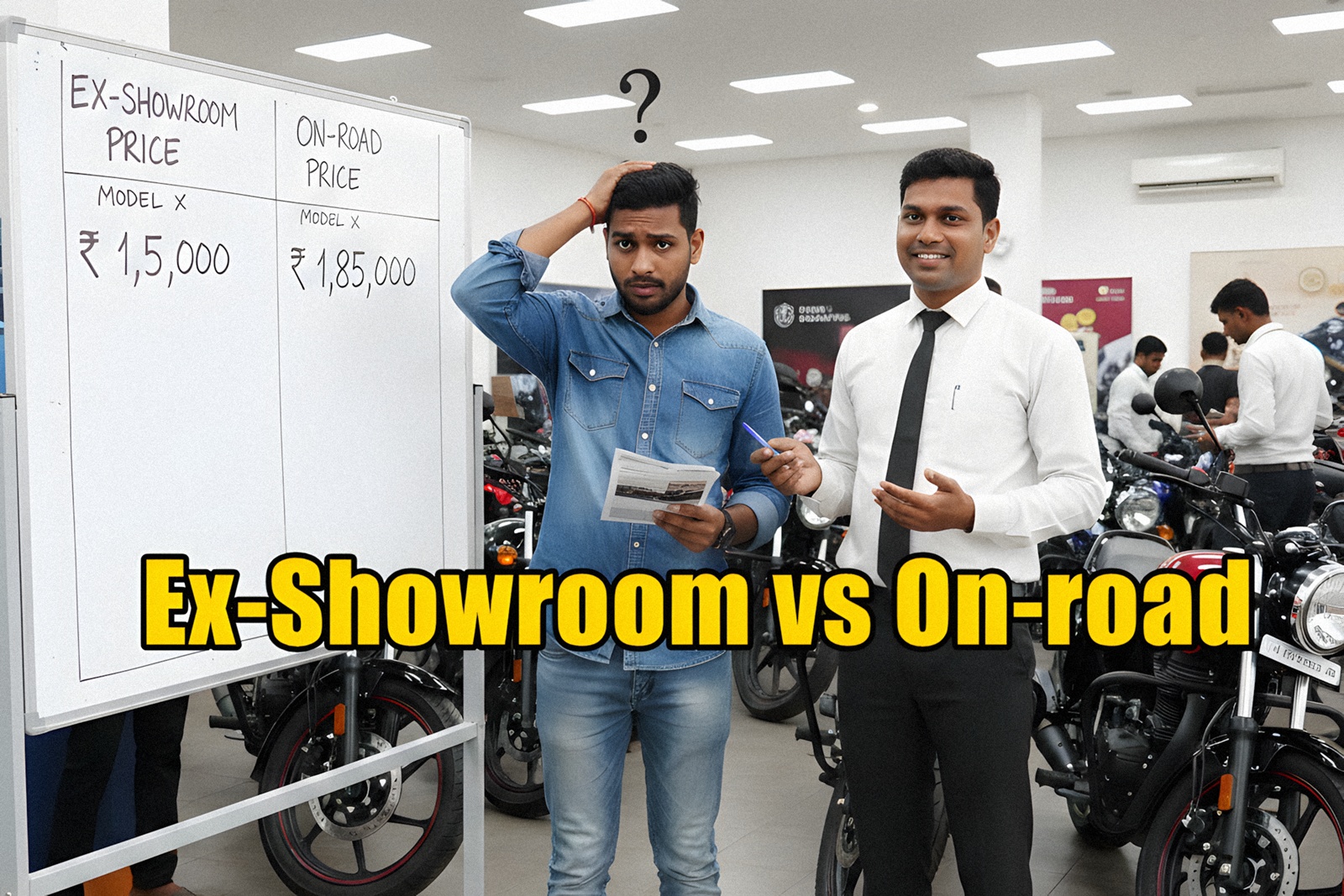
Buying a new motorcycle or scooter is an exhilarating experience. You’ve researched the models, taken test rides, and finally decided on the perfect two-wheeler that suits your style, budget and needs. You check the price online or in a magazine, and it seems well within your budget.
However, when you walk into the dealership and ask for the final price, the figure is often 20% to 30% higher than the advertised price.
This disparity can be shocking, leading to last-minute financial stress. The reason for this gap is the difference between the Ex-Showroom Price and the On-Road Price. Understanding this breakdown is crucial for proper financial planning. In this detailed guide, we will break down every component of the on-road price for a bike or scooter in India, provide state-wise tax data, and give you a simple formula to calculate the approximate final cost.
GST rates on two-wheelers in India for 2026 are as follows
Based on engine capacity and vehicle type. The ex-showroom price that you see is inclusive of this GST rate.
- Two-wheelers with engine capacity ≤ 350cc: 18% GST
This rate was reduced from 28% following the 56th GST Council meeting in September 2025, making smaller commuter bikes and scooters more affordable. - Two-wheelers with engine capacity > 350cc: 40% GST
Premium and larger motorcycles are now taxed at this higher rate, up from the previous 28% GST plus 3% cess (totaling ~31%). - Electric two-wheelers (EVs): 5% GST
Maintained as a concessional rate to promote green mobility and reduce the total cost of ownership. - Used two-wheelers: 18% GST on the profit margin
Applicable when sold by registered dealers; private sales are generally exempt.
1. The Breakdown: Ex-Showroom vs. On-Road Price
To understand the on-road price, we must first understand what the ex-showroom price actually is.
What is the Ex-Showroom Price?
The ex-showroom price is the cost of the vehicle as it leaves the factory floor. It includes:
- Manufacturing Cost + Manufacturer margin: The actual cost of producing the bike + profit margin of manufacturer.
- GST (Goods and Services Tax): In India, two-wheelers are subjected to a 5% to 40% GST depending on vehicle type and cubic capacity.
- Dealer Margin: The profit made by the dealer for selling the vehicle.
Critically, the ex-showroom price does not include the cost of registering the vehicle, insuring it or transporting it to the local showroom.
What is the On-Road Price?
The on-road price is the total amount you need to pay to legally take the vehicle out of the showroom and ride it on public roads. It is the sum of the ex-showroom price and several other mandatory and optional charges.
On-Road Price = Ex-Showroom Price + RTO Registration Charges + Insurance + Miscellaneous Charges
2. Mandatory Components of the On-Road Price
A. RTO Registration Charges (Road Tax)
This is usually the largest component added to the ex-showroom price. In India, transportation is a state subject, meaning every state government has its own Road Tax structure. This tax is paid to the Regional Transport Office (RTO) to register your vehicle and issue a license / number plate.
Road tax is generally calculated as a percentage of the ex-showroom price, and it varies based on:
- The State: Some states have higher taxes than others.
- Engine Capacity: Generally, higher engine capacity (CC) attracts higher taxes.
- Vehicle Type: Scooters sometimes have different slabs than motorcycles.
- Fuel Type: Electric vehicles often have reduced or zero road tax in many states to promote green energy.
B. Vehicle Insurance
According to the Motor Vehicles Act, it is illegal to ride a vehicle without valid insurance. Insurance is a mandatory component of the on-road price.
There are two main types of insurance:
- Third-Party Insurance (Mandatory): Covers damages caused by your vehicle to a third party (person or property). It does not cover damages to your own bike.
- Comprehensive Insurance (Highly Recommended): Covers third-party liability and damages to your own vehicle due to accidents, theft, natural disasters, or fire.
Most dealers will bundle a 5-year third-party policy with a 1-year own-damage policy for new vehicles. Regardless of what a dealership says, you are allowed to choose from a different insurance provider than what the dealers offer. You might even find the same insurance provider giving a better rate if you approach them directly. Yes, it is a hassle and there will be a lot of pressure from the dealer, but it is within your right to choose the insurance best for you.
C. Registration Fees and Smart Card
Apart from the road tax, you have to pay a nominal fee to the RTO for the registration process itself, the issuance of the Registration Certificate (RC) Smart Card, and the High-Security Registration Plate (HSRP).
3. Miscellaneous Charges (Often Negotiable)
A. Logistics/Handling Charges
Dealers often charge a fee for transporting the vehicle from the factory to the showroom and preparing it for delivery (cleaning, oil filling, etc.). While common, these charges are sometimes inflated.
B. Extended Warranty
Manufacturers offer a standard warranty (e.g., 2 years or 30,000 km). Dealers will strongly encourage you to purchase an extended warranty for an additional 2-3 years. This is not mandatory, though it is recommended for peace of mind.
C. Accessories
Crash guards, seat covers, floor mats (for scooters), and chrome kits are not part of the base vehicle. The dealer will add these to the on-road price. You can choose to skip these or buy them from local shops for cheaper prices.
4. State-Wise RTO Registration Rates (Indicative)
Note: These rates are subject to change by state governments. The figures below are indicative for petrol two-wheelers. Electric vehicle taxes are generally much lower.
| State | Indicative Road Tax (%) |
| Karnataka | 12% – 18% (Highest in India) |
| Maharashtra | 10% – 12% |
| Delhi | 8% – 10% |
| Tamil Nadu | 8% – 10% |
| Uttar Pradesh | 8% – 10% |
| West Bengal | 5% – 7% |
| Gujarat | 6% – 8% |
| Kerala | 8% – 10% |
| Punjab | 6% – 8% |
| Rajasthan | 8% – 10% |
5. Indicative Insurance Rates
Insurance premiums depend heavily on the Insured Declared Value (IDV) of the bike—which is the maximum amount the insurer will pay if the bike is stolen or totalled—and the engine capacity. For a brand new bike / scooter it is usually very close to the ex-showroom price.
| Engine Capacity | Third-Party (5 Years) | Comprehensive (1 Year) | Total Premium (Approx) |
| < 75cc | ₹1,500 – ₹2,000 | ₹1,000 – ₹1,500 | ₹2,500 – ₹3,500 |
| 75cc – 150cc | ₹2,500 – ₹3,500 | ₹1,500 – ₹2,500 | ₹4,000 – ₹6,000 |
| 150cc – 350cc | ₹4,000 – ₹5,500 | ₹2,500 – ₹3,500 | ₹6,500 – ₹9,000 |
| > 350cc | ₹7,000 – ₹10,000 | ₹4,000 – ₹6,000 | ₹11,000 – ₹16,000 |
6. How to Avoid Overpaying: Tips for Buyers
- Do Your Own Research: Don’t rely solely on the dealer’s quote. Use online tools like the Parivahan website or online vehicle marketplace websites to check the average on-road price for your city.
- Compare Insurance: Dealers often have tie-ups with specific insurers and may charge a premium. You can buy insurance online yourself and save significantly.
- Refuse Unnecessary Add-ons: You are not obligated to take accessories or maintenance packages offered by the dealer. Always remember, while a 5 year warranty sounds great, it also means you can only go to the authorised centre for those 5 years as well for service and other work.
- Check Handling Charges: If the logistics charges seem excessively high, ask for a breakdown.
7. The Final Formula
To calculate the approximate on-road price, use the following formula:
{On-Road Price} = P + (P \times R) + I + M
Where:
- P = Ex-Showroom Price
- R = RTO Road Tax Percentage (expressed as a decimal, e.g., 10% = 0.10)
- I = Insurance Premium (Third-party + Comprehensive)
- M = Miscellaneous Charges (Handling + Accessories)
Example Calculation
Imagine you are buying a scooter in Maharashtra with an ex-showroom price of ₹80,000.
- Ex-Showroom (P): ₹80,000
- Road Tax (R): 10% (0.10) of ₹80,000 = ₹8,000
- Insurance (I): Approximate for 150cc = ₹5,000
- Misc (M): Handling charges = ₹1,000
On-Road Price = 80,000 + 8,000 + 5,000 + 1,000 = ₹94,000
By understanding these components, you can budget accurately and ensure you are paying a fair price for your new ride.
Comment below if you want to know the on-road price for any bike or two wheeler along with your location and I can find it for you.